AI Context Sprint Lite
30 days. One team. One workflow. AI that actually moves delivery metrics.
A fixed-scope engagement to build workflow-specific context, guardrails, and a pilot—then measure what changed on delivery metrics you already care about. Workflow context means the decisions, conventions, examples, and guardrails a team normally has to reconstruct by hand every time.
When this fits
- You know which workflow needs help (for example code review, incident response, or design-to-merge).
- You provide one workflow owner and 1–2 practitioners who know the work. Vetratek works alongside them to scope, configure, pilot, and measure the workflow—not replace them.
- The team already uses AI tools, but outputs are inconsistent and metrics are flat.
- You want measurable before/after on agreed delivery signals—not slide decks.
- You can commit a small core team for working sessions and source access within scope.
- You want to own the prompts, bundles, and operating model after the sprint.
Why 30 days is realistic
Sprint Lite is not an enterprise AI transformation program. It works because we choose one bounded workflow, one participating team, and a source scope narrow enough to implement and measure quickly.
If the workflow requires cross-enterprise redesign, major platform replacement, or unresolved ownership across multiple teams, it is not a Sprint Lite candidate. That is exactly what the Diagnostic is designed to determine.
The discipline is in the scoping.
What you build in 30 days
Expand each item for concrete examples of what lands in the sprint inventory—not a full project plan, but enough to see what you are buying.
Common first workflows
Sprint Lite works best when one bounded workflow is the target. Common starting points:
- Code review — PR cycle time, time to first reviewer response, revision rounds per PR
- Incident response handoff — time to first responder context, escalation accuracy, postmortem completeness
- Design-to-merge / spec drafting — spec cycle time, revision rounds, downstream rework rate
- Onboarding and knowledge handoff — time to first PR merged, time to first incident handled, ramp-up confidence
If your workflow isn't on this list, the Diagnostic is the right starting point.
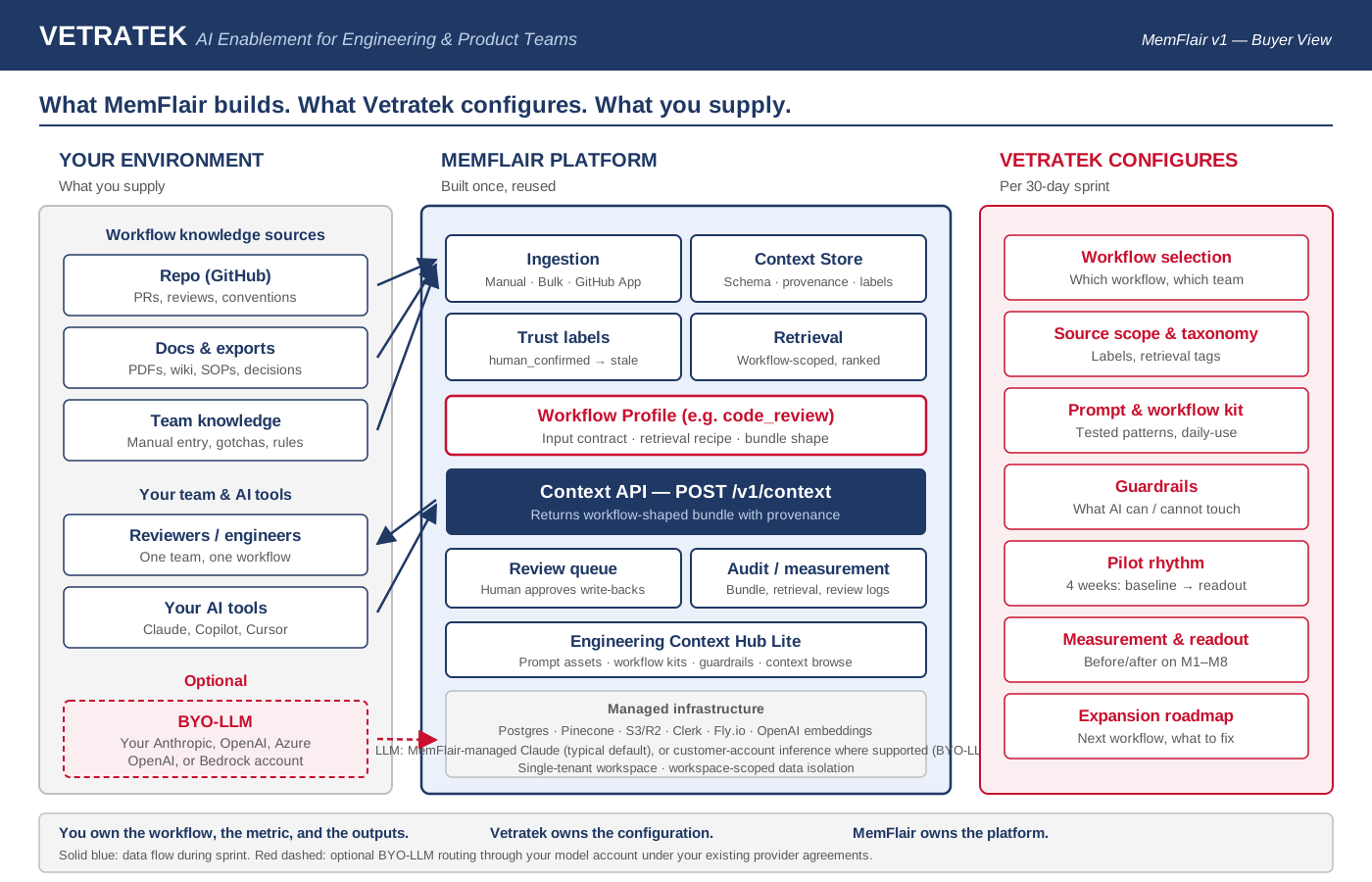
Buyer architecture
Same separation as the homepage: your workflow and sources, MemFlair's platform layer, Vetratek's sprint configuration and readout.
Who joins the sprint
You bring
- One workflow owner who can sponsor the pilot
- One or two practitioners who actually do the work
- Approved access to in-scope sources (repos, docs, tickets)
- Availability for the week 1 charter, weekly checkpoints, and week 4 readout
We bring
- Sprint scoping, workflow-context configuration, and guardrails
- Pilot operating rhythm, retrieval tuning, and reviewer support
- Measurement against the metrics agreed in week 1
- The week 4 readout and expansion recommendation
We work alongside your team, not in a side lane. We do not embed or replace practitioners.
Four-week timeline
Week 1
Workflow definition, baseline collection, and approved source inventory.
Week 2
Context loading, trust labeling approach, and workflow configuration.
Week 3
Pilot usage with guardrails and reviewer loop.
Week 4
Measurement, hardening, and executive readout.
Measurement model
Baselines and metric definitions are set in week 1—not retrofitted after the pilot.
Outcome metrics
- PR cycle time
- Time to first reviewer response
- Revision rounds per PR
Usage metrics
- Bundle requests per PR
- Unique reviewers using bundles
- Prompt-kit usage rate
Quality metrics
- Bundle relevance rating
- Write-back approval rate
- Stale-suppression effectiveness
What a Week 4 readout looks like
Download an illustrative sample readout (PDF)
Mocked from a hypothetical engagement, not a real customer. Provided so you can see the artifact shape—baseline-to-pilot comparisons, reviewer feedback, failure modes observed, and expansion recommendation—before committing to a sprint.
We benchmark against your current workflow, not generic industry averages.
The Week 4 readout is not a celebration deck. It is an expansion decision: what improved, what did not, and whether to scale, adjust, or stop.
After the sprint, ongoing MemFlair platform access, workflow updates, monitoring, or expansion support can be scoped separately based on the readout.
Sprint Lite is not the full transformation roadmap. It is the first proof point: one scoped workflow, implemented and measured, so the next roadmap decision is grounded in evidence instead of AI theater.
Security & LLM posture
MemFlair-managed Anthropic Claude remains the standard default for early platform-backed pilots. BYO-LLM can be scoped where supported, allowing inference to route through your Anthropic, OpenAI, Azure OpenAI, or AWS Bedrock account. Embeddings remain MemFlair-managed in v1. Exact processing roles depend on counsel-reviewed agreements for your environment.
In v1, embeddings remain MemFlair-managed even when you route chat completions through a customer-controlled inference endpoint. That means customer text used for embeddings leaves your environment for embedding generation; we surface this plainly in the security packet before data moves.
A security questionnaire packet is available before sensitive data is shared. See the Security page for data flow, retention, and known gaps.
What is not included
- Multi-team rollout or enterprise-wide change management.
- Net-new platform engineering or greenfield tooling programs.
- Custom enterprise integrations beyond the approved source scope for the pilot.
- Formal security audit, penetration test deliverable, or compliance certification.
- Full source-system permission mirroring or IAM replication.
Investment
- $25,000–$35,000 design partner pricing for qualified engagements.
- $40,000–$60,000 standard pricing after the first cohort, scoped in writing.
- Diagnostic fee credited toward Sprint Lite when you sign within 30 days of the diagnostic readout, if applicable.