Pick one workflow. Improve it in 30 days. Prove whether it is worth scaling.
30 days. One team. One workflow.
AI that actually moves delivery metrics.
Not an enterprise AI transformation program. A scoped proof point for one workflow.
Vetratek helps engineering and product teams turn existing AI tools into measurable workflow improvement through the AI Context Sprint Lite, powered by MemFlair's workflow-context layer. Workflow context means the decisions, conventions, examples, and guardrails a team normally has to reconstruct by hand every time.
AI adoption is not the bottleneck. Shared context is.
The problem
Tools are in place. Context is not.
The problem is not access to AI tools. It is that critical workflow context stays fragmented across the work itself.
Code reviews restart from partial context
Reviewers repeatedly reconstruct architecture decisions, conventions, and known risks before they can judge the change in front of them.
Specs lose prior rationale
Requirements, trade-offs, and decisions live across meetings, docs, and team memory, so product and engineering restart work from incomplete context.
Onboarding depends on tribal knowledge
New hires spend weeks discovering what experienced teammates already know because the workflow context is not reusable.
AI use stays individual
Teams adopt Copilot, Claude, ChatGPT, or Cursor, but delivery workflows do not change because shared context never enters the system.
The result is repeated work, slower ramp-up, generic AI outputs, and no clear path from AI tool access to measurable workflow improvement.
CTOs see AI spend without delivery movement.
Engineering leaders see recurring workflow friction.
Practitioners feel every task starting cold.
Offer
Diagnostic first, then a scoped sprint
Diagnostic identifies the workflow worth targeting. Sprint Lite builds, pilots, and measures the improvement.
Diagnostic: Which workflow is worth targeting first? Sprint Lite: Can we improve that workflow in 30 days and prove it?
AI Context Diagnostic
- 5 business days
- $2,500–$3,500
- Discovery workshop
- Context fragmentation map
- Go/no-go Sprint recommendation
- Sprint scope and defensible price
AI Context Sprint Lite
- 30 days · one team · one workflow
- Sprint Lite builds on that clarity with implementation, pilot execution, and a measured readout.
- $25K–$35K design partner pricing
- Measured before/after on agreed delivery metrics
- Context catalog, prompt/workflow kit, guardrails
- Pilot workflow and week-4 readout
- Platform-backed engagements use MemFlair, with founding design-partner co-builds available during the build window.
Standard Sprint Lite pricing after the first cohort is typically $40K–$60K, subject to scope. Co-build design partner engagements are available during the build window where there is a mutual fit.
Start with the Diagnostic when the workflow is unclear. Start with Sprint Lite directly when the workflow is already known—we still baseline and measure in week 1.
The first win is not an organization-wide roadmap. It is one scoped workflow that can be improved, measured, and used to decide what comes next.
In the sprint
What happens in 30 days
Workflow baseline
Minimum viable context catalog
Prompt and workflow kit
Lightweight AI guardrails
Pilot workflow delivery
Measured readout + expansion roadmap
Architecture
How the pieces fit
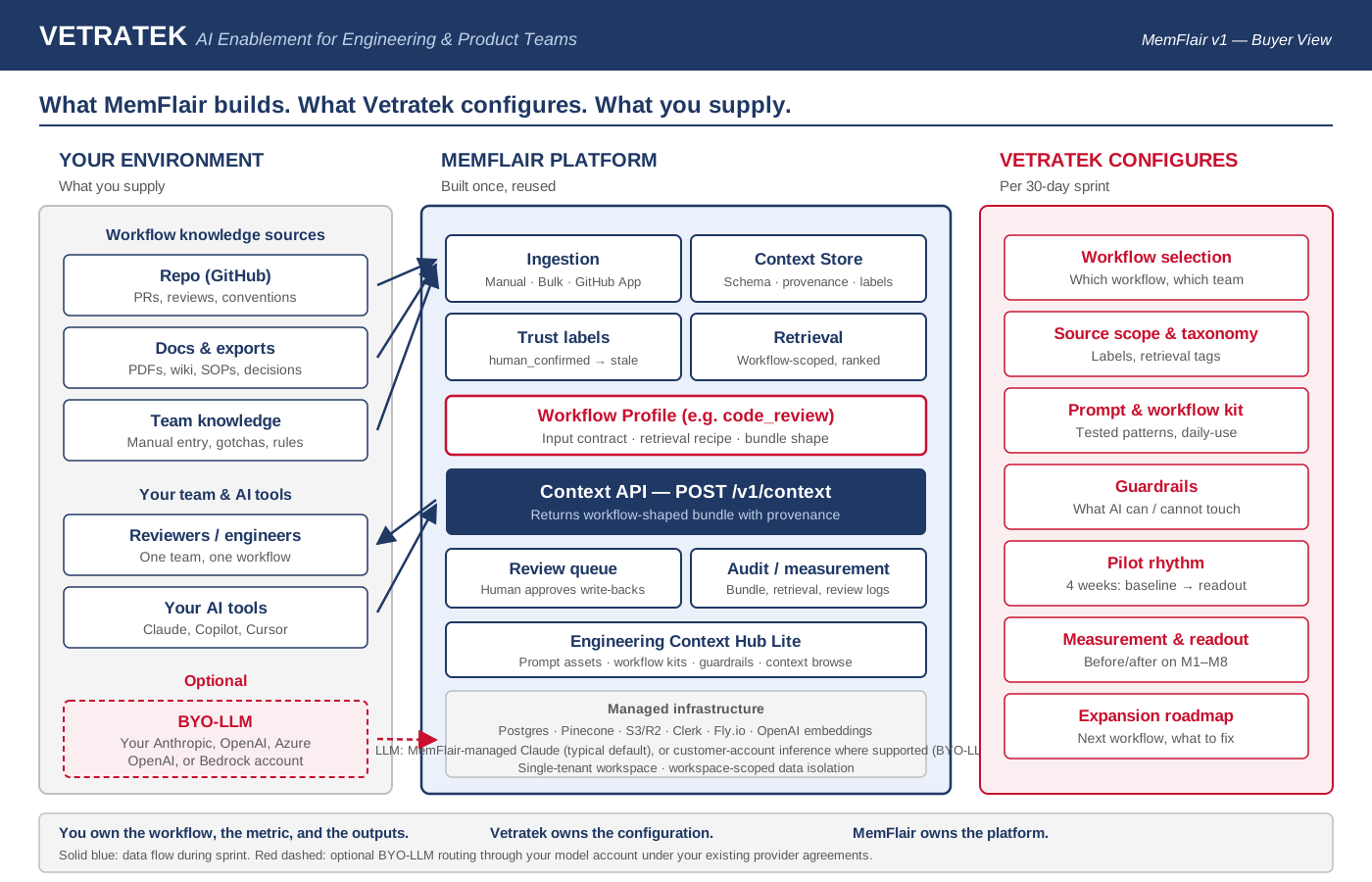
What you supply
- Named workflow and practitioners
- One workflow owner and 1–2 practitioners who know the work
- Approved sources (repos, docs, tickets)
- BYO-LLM can be scoped where supported (Security for full posture)
What MemFlair builds
- Workflow-context platform (ingestion, catalog, retrieval, API)
- Trust labels, review queue, and measurement hooks
What Vetratek configures
- Sprint scope, guardrails, and pilot cutline
- Prompt/workflow kit aligned to your SDLC
- Readout against week-1 baselines
Common first workflows
- Code review
- Incident response handoff
- Design-to-merge / spec drafting
- Onboarding and knowledge handoff
If your workflow isn't on this list, the Diagnostic is the right starting point.
Measurement
How we measure
We group metrics into outcome, usage, and quality. Everything is agreed before the pilot runs—no retrofitted success stories.
Outcome metrics
- PR cycle time
- Time to first reviewer response
- Revision rounds per PR
Usage metrics
- Bundle requests per PR
- Unique reviewers using bundles
- Prompt-kit usage rate
Quality metrics
- Bundle relevance rating
- Write-back approval rate
- Stale-suppression effectiveness
Metrics are defined in week 1, baselines are collected before the pilot, and the week 4 readout reports what actually happened.
We benchmark against your current workflow, not generic industry averages.
The Week 4 readout is not a celebration deck. It is an expansion decision: what improved, what did not, and whether to scale, adjust, or stop.
Curious what a readout looks like? See an illustrative sample (PDF).
The business case is intentionally bounded
- Cost: A fixed-scope 30-day engagement, not an open-ended transformation program.
- Return: A measured readout showing whether one workflow improved enough to justify expansion.
- Downside: You commit to one fixed-scope engagement, not a multi-quarter program you have to unwind. If the signal is weak, you stop after one workflow instead of funding a broad AI bet.
Security
Posture you can review before data moves
Security questionnaire packet available before any data is shared. It covers data flow, processors, tenant isolation, access controls, retention, deletion, and known v1 gaps.
MemFlair-managed Anthropic Claude remains the standard default for early platform-backed pilots. BYO-LLM can be scoped where supported, allowing inference to route through your Anthropic, OpenAI, Azure OpenAI, or AWS Bedrock account. Embeddings remain MemFlair-managed in v1.
Single-tenant sprint workspace, processor list, and BYO-LLM boundaries are summarized on the Security page, including known v1 gaps for embeddings and retention.
Who this is for
Engineering and product leadership
CTOs, VPs of Engineering, Heads of AI, and product leaders ready to commit one team to one workflow and measure whether AI improves delivery.
Not for teams looking for AI demos or one-off experiments.
Trust
Veteran-owned, engineering-led
Vetratek is led by Matthew Magee, with senior engineering leadership and hands-on security experience. We bias to scope discipline, measurable outcomes, and candid limits on what v1 includes.
SBA-Certified SDVOSB · SAM Registered